NASA plane makes fiery emergency landing in Texas (VIDEO)
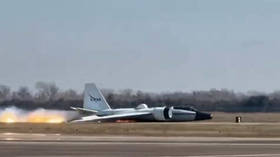
Dramatic video footage has captured the moment a NASA research plane was forced to make a fiery emergency ‘belly landing’ at a Texas airport on Tuesday after suffering a technical problem.
Footage shared on social media shows flames billowing from the bottom of the WB-57 jet as it skidded along the runway with its landing gear not deployed.
NASA spokesperson Bethany Stevens confirmed the incident in a statement released shortly after the landing.
“Today, a mechanical issue with one of NASA’s WB-57s resulted in a gear-up landing at Ellington Field,” Stevens said in a post on X, stressing that all crew members are safe.
“As with any incident, a thorough investigation will be conducted by NASA into the cause,” she added.
The WB-57 is a high-altitude research aircraft used by NASA for scientific missions, including atmospheric studies, Earth science observations, and support for spaceflight research. The jet, a modified military aircraft, the Martin B-57 Canberra, is capable of flying at extreme altitudes.
The Johnson Space Center has three such aircraft, which have been flying research missions since the early 1970s. In the WB-57, the pilot and sensor equipment operator sit in tandem. The airplane has a range of approximately 4,000km (2,500 miles) and an endurance of more than six hours. It is not yet clear how much damage the airframe sustained in the hard landing or how long it will be out of service.